



International Center for Community Land Trusts
We are a not-for-profit nongovernmental organization established in 2018 to promote and to support community land trusts and similar strategies of community-led development on community-owned land in countries throughout the world.
Photo of Grupo Esperança community and the Favela-CLT Project (Catalytic Communities, Brazil)
Find what you need
CLTs in the News
‘Artist Space Trust’ Opens Applications for Affordable Duplex In SF’s Mission District, Leanne Maxwell, AFiST, October 12, 2026
Lahaina Community Land Trust to steward Kainehe, ʻāina momona that once fed Lahaina people, Maui Now, October 8, 2026
‘Like a miracle’: Chinatown Land Trust on brink of buying its first property, Emma Johnston-Wheeler, Toronto Today, October 7, 2026
150-home, mass-timber development in Huntsville marks Muskoka CLT’s first official housing initiative, Daily Commercial News, October 1, 2026
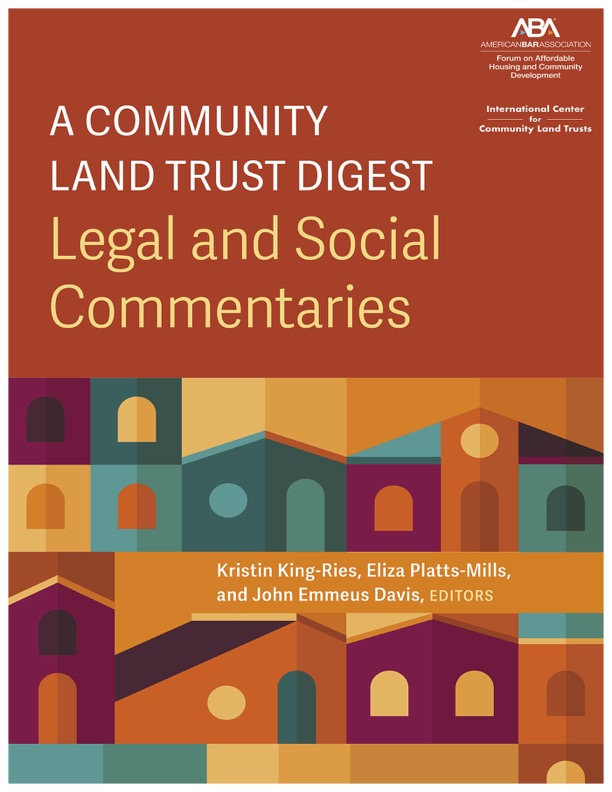
A Community Land Trust Digest
Edited by Kristin King-Ries, Eliza Platts-Mills, and John Emmeus Davis
A joint publication of the American Bar Association and the International Center for Community Land Trusts
A selection of these previously published articles, appearing in print between 1982 and 2023, are collected here for the first time in a single volume. This digest brings together legal and social perspectives on the CLT model, tracing its roots in the U.S. Civil Rights Movement through its modern applications. It features contributions from an outstanding editorial board of scholars and practitioners from institutions including Columbia, Yale, Notre Dame, UT Austin, UC Irvine, Vermont Law, NYU, Boston College, the University of Puerto Rico, and more. The articles in the book are aimed both at readers being introduced to CLTs for the first time and readers with significant CLT experience looking to answer deeper questions.
This ebook can be purchased at the ABA’s website, and if you use our discount code “ICCLT30”, you will receive 30% off the retail price.
Joint Publications with the Lincoln Institute of Land Policy
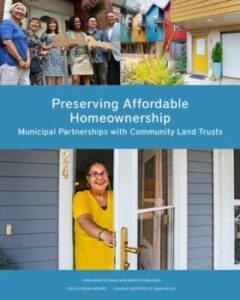
Preserving Affordable Homeownership: Municipal Partnerships with Community Land Trusts, by John Emmeus Davis and Kristin King-Ries of the International Center for Community Land Trusts, draws on insights from 115 community land trusts (CLTs) that were interviewed or surveyed by the International Center for Community Land Trusts, the report explores how CLTs are partnering with public officials to help address the housing affordability crisis.
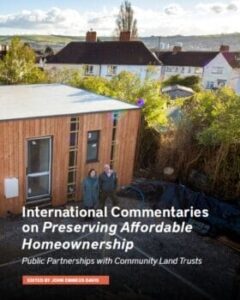
International Commentaries on Preserving Affordable Homeownership is a collection of six global commentaries which expands upon Preserving Affordable Homeownership. Featuring perspectives from Australia, Canada, Brazil, Europe, France, and the United Kingdom, the commentaries describe experiences and evolving projects from each area and share insights on what those experiences and projects have in common with—and how they differ from—community land trusts (CLTs) in the United States.