


Over the past thirty years, the land trust has emerged as a preferred model for holding land for community gardens and urban farms. This reflects the convergence of two trends: the creation of specialized open space land trusts to conserve land for community gardens, and the moves that some community land trusts have made to promote urban agriculture.
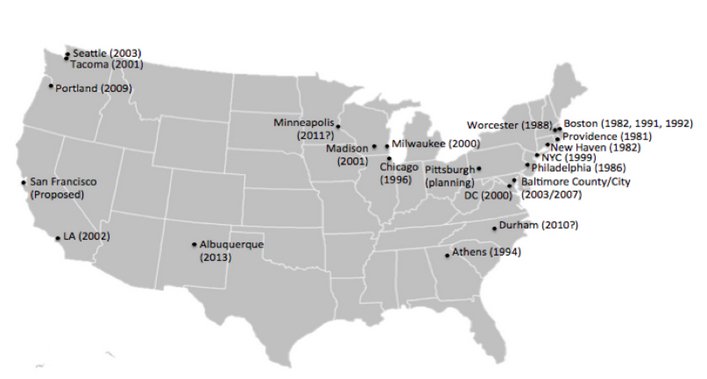
The main distinction here is between open space land trusts and community land trusts. Open space land trusts focus on protection of land, and generally do not have structures in place to manage lands that are being used productively, or to foster community-based governance.Community land trusts, by contrast, acquire and hold land for the benefit of a community, and generally have tripartite board structure that includes seats dedicated to both beneficiaries of the trust (generally people who live in housing held by the trust) and members of the neighboring community.
To illustrate the different forms that such trusts can take, we provide four brief case studies. In the section on the Central Server Model, we dig deeper into the model developed by Chicago’s NeighborSpace land trust.
Open Space Land Trusts
NeighborSpace
NeighborSpace is a land trust that holds land for community gardens and, increasingly, urban farms in Chicago. It was founded in 1996 in response to a recommendation in a city planning report that found Chicago ranked 18th among 20 major cities in terms of open space per capita. NeighborSpace was created by an intergovernmental agreement approved by the Chicago City Council, the Cook County Board of Commissioners, and the board of the Chicago Park District. It operates as a nonprofit, but with significant support and oversight from government. Each of the governmental founders provides $100,000 per year in funding, and has three seats on the NeighborSpace board.
NeighborSpace currently holds just over 100 properties in the city of Chicago. Most are community gardens, but around 2010, the land trust began to hold larger properties for urban farms. This followed a decision by the NeighborSpace board of directors that urban farming fit within its mission so long as farms are nonprofit, do not have permanent structures on NeighborSpace sites, and are not too large for their neighborhood context. Honore Street farm in Englewood, a nearly one-acre site operated by Growing Home, became the first piece of farmland held by NeighborSpace. The land trust later took ownership of 2.5 acres of land in East Garfield Park, which are being farmed by Chicago FarmWorks, a nonprofit which distributes the produce via the Greater Chicagoland Food Depository.
In 2015, NeighborSpace began facilitating a planning process to determine a land tenure model for for-profit farms in Chicago. Currently, for-profit farms tend to lease land from private landowners. The ongoing process envisions that either NeighborSpace or a new entity would hold land in trust for a nonprofit farming cooperative, the members of which could themselves be nonprofits or for-profits.
New York Community Garden Land Trusts
In 1999, the administration of Mayor Giuliani announced a plan to auction off over one hundred pieces of city-owned land that were home to community gardens. Gardeners and their allies mobilized in resistance to the plan, organizing demonstrations and filing lawsuits. In 2002, these lawsuits resulted in a negotiated settlement with Mayor Bloomberg’s administration, in which 69 gardens were purchased and held in trust by the Trust for Public Lands (TPL). The New York Restoration Project (NYRP), a nonprofit founded and funded by the actress Bette Midler, took ownership of dozens more gardens.
In the years since, TPL established three local land trusts to hold and manage the gardens: the Manhattan Land Trust, the Brooklyn-Queens Land Trust, and the Bronx Land Trust. The board of each of these land trusts is composed of a mix of community garden leaders and staff from New York City nonprofit organizations. NYRP has taken on a broader mission, to provide green space to underserved areas of the city, and is led not by gardeners but rather a range of New York philanthropists, businesspeople, and civic leaders. Some of its sites have been renovated with support from corporations such as Target, and have reduced the space available for community-managed gardens, in favor of tidy pocket parks.
Community Land Trusts
Since the 1960s, the Community Land Trust was developed as a support for affordable housing in the United States. In the housing sector, the CLT model combines two basic innovations in governance of land. The first innovation is to split the ownership of a home from ownership of land on which it sits. A homeowner in a CLT holds title to her home, while the title to the land is held by the nonprofit CLT, which then provides a ground lease to the homeowner. This allows CLT homeowners to build limited equity in their home itself, while ensuring affordability to subsequent homeowners by limiting the amount which they can increase the sales price of the land. The second innovation is the tripartite structure of the CLT board, whose members are generally split evenly between homeowners, members of the neighboring community who are not part of the CLT, and the types of community leaders (representatives from other non profits, credit unions, etc.) that one typically associates with a nonprofit board. This board structure ensures that the CLT remains committed to balancing the interests of its members and those of the community in which it exists.
In recent years, CLTs have come to take on three main roles in support of urban agriculture. First, some CLTs formed to support affordable housing have come to hold land for community gardens and urban farms. Second, some of these housing-focused CLTs have provided programmatic support for urban agriculture, other than taking on ownership of land. And a few organizations have been founded as community land trusts that are exclusively focused on urban agriculture, adapting some of the techniques for community-focused governance from the CLT model developed in housing. Here we focus on two CLTs. (1) the Athens Community Land Trust, which was founded with a mission to create affordable housing, but has begun to provide programmatic support for urban agriculture; and (2) the Southside Community Land Trust, which focuses on preserving land for community gardens and urban farms.
Athens Land Trust
The Athens Land Trust, in Athens, Georgia, is a dual-mission housing and open space land trust. Rather than taking ownership of land for growing, the Athens Land Trust has engaged in urban agriculture exclusively through program assistance. It opted for this role because of the high holding costs associated with Georgia’s property taxation policies. These assesses land owned by the CLT at its unrestricted market value, rather than at the value of land that is restricted to agricultural use.
The Athens Land Trust provide support for local agricultural projects by partnering with public and private sector landowners. For example, when a new pastor arrived at Hill Chapel Baptist Church in Athens, he was concerned about the health issues affecting the African American community, including hypertension, diabetes, and obesity. He became an advocate for more nutritious food opportunities and a healthier food culture. The Athens Land Trust’s staff worked with the church to design a community garden located on church-owned land, and helped arranging for testing and tilling the soil, coordinating workdays, providing plant materials, and teaching gardening workshops. Similarly, at the West Broad Market Garden, the Athens Land Trust designed and constructed a community garden on the site of a former elementary school. Today, the site houses several programs managed by the Athens Land Trust, including a commercial agricultural garden, a produce stand, and a community-supported agriculture program. The Athens Land Trust plans to add a farmer’s market component in the near future.
As a dual-purpose land trust, the Athens Land Trust is particularly well qualified to conduct agricultural projects. They have also secured funding necessary to advance their urban agricultural program by partnering with a local university to create, maintain, and expand a total of 15 community gardens and 20 school gardens.
Southside Community Land Trust
Southside Community Land Trust (Southside CLT) holds title to 16 community gardens in Providence, Rhode Island. Like the Athens Land Trust, Southside CLT provides programmatic support (such as arranging for bulk purchases of organic fertilizers) for these gardens as well as the 25 gardens in its network that are owned by other organizations. Southside differs from other community land trusts in that it only holds land for gardens and farms, rather than for affordable housing. However, like traditional CLTs, it has built community representation and engagement into its governance structure. Fifty-one percent of board members must be elected directly from gardeners.
Southside has drawn on land conservation tools developed in suburban contexts in order to raise revenue and provide additional levels of protection for its community gardens. It sold the development rights to a number of its gardens to the Rhode Island Department of Environmental Management (DEM), and used revenues from the sales to help offset the cost of acquiring land. Selling development rights to the state also helps to increase security, since a developer would need to acquire both title to the garden and the development rights. The use of a state open-space bond to finance the purchase of the development rights further restricts potential land uses, and adds to security of tenure.
In addition to protecting land for community gardens, Southside CLT also manages two commercial farms. City Farm is a ¾-acre commercial urban farm in south Providence, begun in 1986. Urban Edge Farm is a 50-acre farm located eight miles from South Providence in Cranston, Rhode Island. The mission of Urban Edge Farm is to support seven new farmers, who collaboratively manage the land. The land for Urban Edge was purchased by the state in 2002, pursuant to the state’s Open Space Preservation Act. The site, which was formerly a dairy farm, is now owned and protected by the Rhode Island Department of Environmental Management, which leases it to SCLT for $1/year. About 20 of the 50 acres are cultivable.
Southside CLT initially operated its own CSA farm at Urban Edge Farm, but within a few years it became clear that production would not cover the significant staffing costs. Through Urban Edge Farm, Southside CLT now teaches farming practices to new farmers, rents them farm equipment, provides compost and fertilizer, and plows the land once a year. After going through training, these beginning farmers can rent up to two acres of land at below-market rates. These farming businesses are owned and operated by individuals who had some prior experience in farming, but who weren’t able to buy or rent land on their own at market rates. They sell through CSAs, directly to institutions, and through growers’ cooperatives. The terms of Southside CLT’s lease with the state are meant to prevent competition with nearby farms, and thus bar on-farm sales or non-farm businesses. Two of the seven farmers are a couple that immigrated from Laos; two of the remaining five worked previously with Southside CLT, having received the opportunity to farm the land after being laid off from the original CSA operation.
Land Trusts Involved in Urban Agriculture
| CITY | LAND TRUST | TYPE |
| Athens, GA | Athens Land Trust | CLT |
| Baltimore, MD | Baltimore Green Space | Open Space |
| Boston, MA | The Trustees of Reservations | Open Space |
| New York City, NY | Bronx Land Trust | Open Space |
| New York City, NY | Brooklyn Queens Land Trust | Open Space |
| Washington, DC | Capitol Hill Community Garden Land Trust | Open Space |
| Boston, MA | Dudley Neighbors, Inc. | CLT |
| Tacoma, WA | Tacoma Urban Land Trust | Open Space |
| Los Angeles, CA | Los Angeles Neighborhood Land Trust | Open Space |
| New York City | Manhattan Land Trust | Open Space |
| Milwaukee, WI | Groundwork Milwaukee | Open Space |
| Chicago, IL | NeighborSpace | Open Space |
| New Haven, CT | Gather New Haven | Open Space |
| Baltimore, MD and Seattle, WA | P-Patch | Open Space |
| Philadelphia, PA | Neighborhood Gardens Trust | Open Space |
| Albuquerque, NM | Sawmill Community Land Trust | CLT |
| Boston, MA | South End Lower Roxbury Open Space Land Trust | Open space |
| Providence, RI | Southside Community Land Trust | CLT |
| Madison, WI | Troy Gardens (Madison Area Community Land Trust) | CLT |
| Minneapolis | Twin Cities Community Agricultural Land Trust | Open Space |
| Portland, OR | Urban Farm Collective | Open Space |
| Worcester, MA | Worcester Common Ground | Open Space |